One open platform. Real workflows, measured honestly.
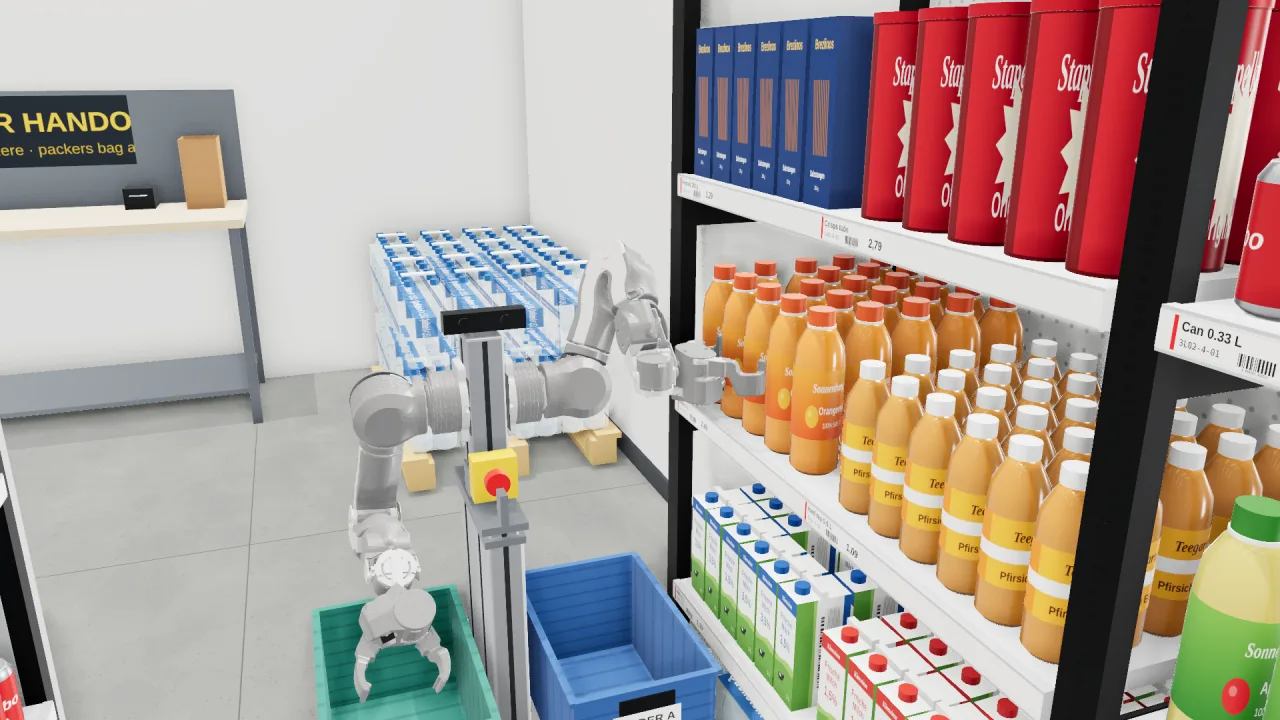
Two applications we are working through with OpenAMRobot: picking in a local grocery hub, and autonomous cleaning of sanitary areas. Both are planning and R&D studies, not finished products. Here is what we found, including what does not work yet.
3,000 SKUs. One robot. What is actually worth automating?
The wrong question
Most grocery robotics conversations start with "Can the robot fulfil the entire order?" For a real hub, that is the wrong starting point.
The better question
How many repetitive, high-frequency item lines can a robot remove from the human workflow every day?
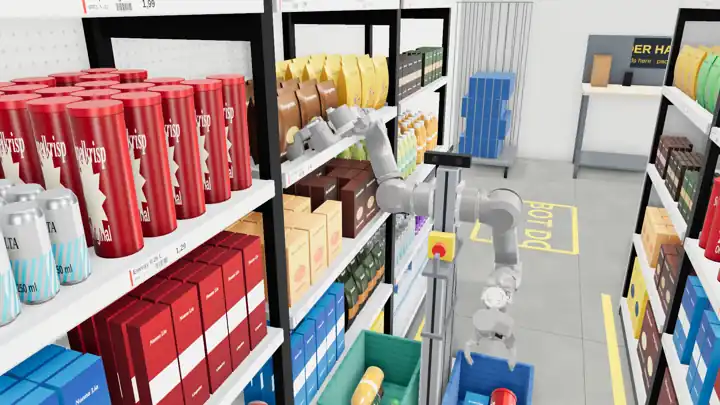
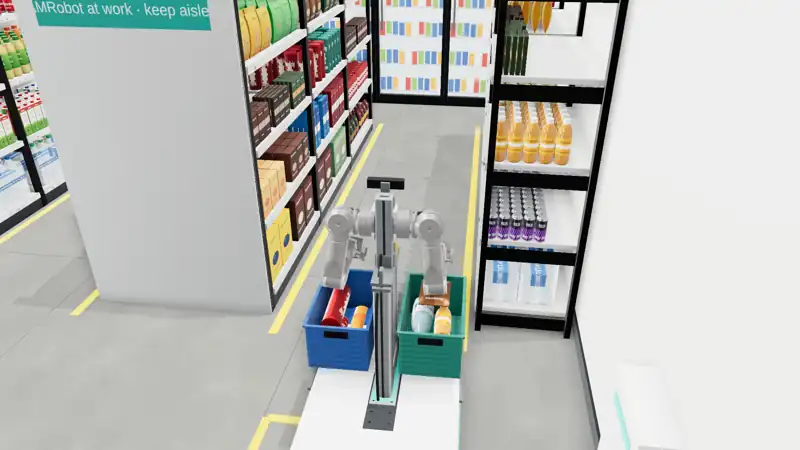
A typical quick-commerce hub
~3,000
SKUs per hub
~350
orders per day
~17
items per order
~5,950
item lines per day
Based on publicly reported figures from a large European quick-commerce operator. SKU-level demand is not public, so everything below is a planning estimate, not a product promise.
30 to 40% of the products, about half of the picks
We estimate that 900 to 1,200 SKUs suit an initial robotic picking process. That is 30 to 40% of the assortment. These are often fast movers, so they could represent 45 to 55% of the daily item lines.
The robot does not need to understand the whole supermarket. It needs to handle the repetitive part of the flow reliably.
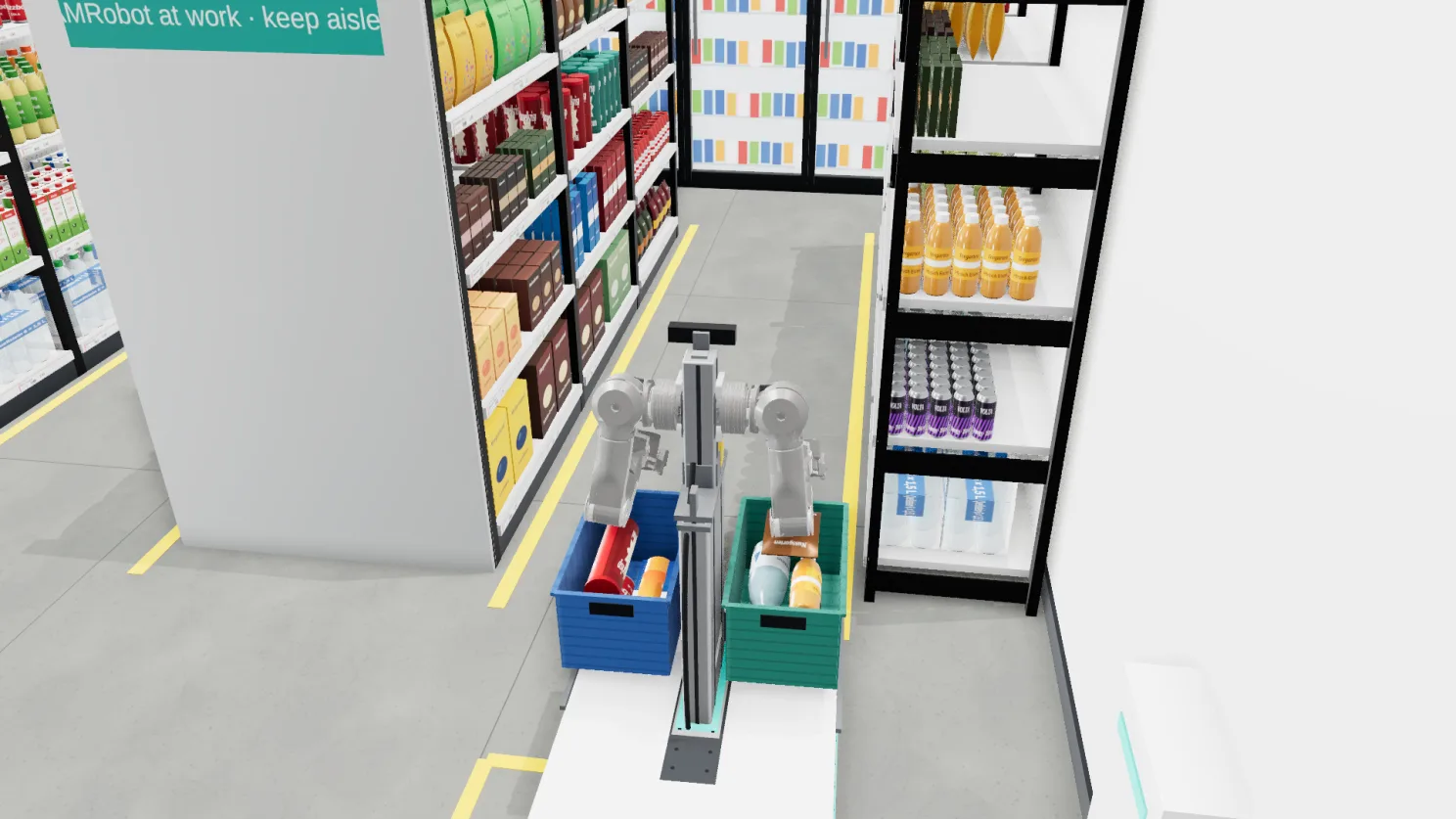
A new capacity layer, not full automation
With a docking station and fast recharge in genuine gaps, we model the robot as available across up to 15 operating hours. Navigation, charging, replenishment and recovery still take time, so it does not manipulate for 15 hours straight.
| Effective picking rate | Picks per day |
|---|---|
| 40 picks per hour | 600 |
| 50 picks per hour (base case) | 750 |
| 75 picks per hour | 1,125 |
12.6%
of all daily item lines
~25%
of the robot-friendly item lines
~44
baskets of items per day, not 44 complete orders
Walking and carrying, not the grasp
At a planning cost of about EUR 18.50 per fully loaded labour hour, the value depends on how much human time each robotic pick removes: finding the product, walking to the shelf, scanning, lifting, carrying it to the station.
| Human time removed per pick | Value per month at 750 picks a day |
|---|---|
| 20 seconds | ~EUR 2,300 |
| 25 seconds | ~EUR 2,900 |
| 30 seconds | ~EUR 3,500 |
| Grasp only, 7 to 11 seconds | ~EUR 800 to 1,300 |
This is capacity value, not a removed job: more orders at peak, time for exceptions and replenishment, less walking for pickers. At 350 orders a day, 30 seconds less rider waiting is almost three rider-hours a day.
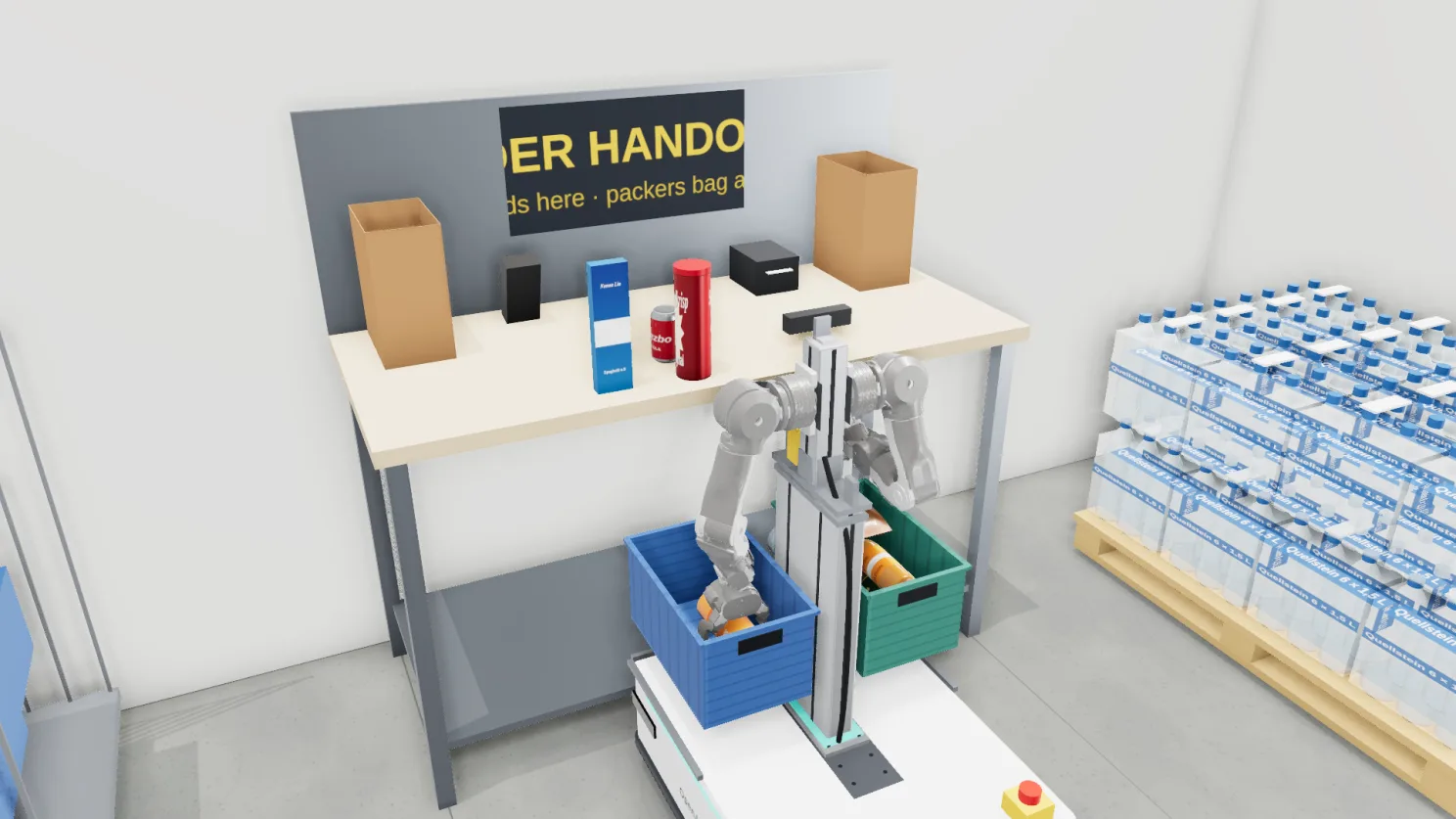
What still has to be solved
These are not side details. They decide whether the robot creates value in a real operation.
- A differential-drive base needs more space and time in aisles
- The lift column does not rotate, which limits reach behind the base and camera orientation
- Not every package offers a reliable grasp
- Flexible, fragile and deformable products remain difficult
- Shelf height, product orientation and stock presentation matter
- Narrow aisles make navigation and human interaction harder
- Exceptions and recovery can destroy the economics
- Payload, safety, cold chain and docking still need validation
Collect data, run controlled experiments, build 3.0
We are collecting SKU packaging, dimensions, order frequency, shelf locations, pick times, walking distance, intervention rates and order-ready delays. Controlled experiments and pilot deployments follow. The results define OpenAMRobot 3.0, starting in January 2027.
A grocery robot does not need to pick everything. It needs to make the whole operation measurably better.
Autonomous toilet cleaning with dry steam.
Why it is hard
Toilet cleaning is much harder than floor cleaning. The robot works in contaminated, wet and reflective spaces with tight geometry and biofilm, and must avoid splash-back, aerosols, excess water and cross-contamination. That needs professional sanitation technology, not a mop on an arm.
Why dry steam
Dry saturated steam carries a lot of heat with very little liquid water. That means better biofilm disruption, less water and chemicals, and less moisture left on surfaces and near the robot's electronics.
~175 °C
dry steam
~8 bar
at the nozzle
100-250
grams per minute
Pulsed
not continuous
Three modules on one robot
Mobile base
- Navigation and localisation
- Obstacle avoidance and mission planning
- Power distribution and docking
Dual-arm upper body
- Positions steam nozzles and cleaning heads
- Handles different tools and fixtures
- Follows precise cleaning paths
Steam-vacuum unit
- Steam generation, valves and pumps
- Pressure and temperature sensors
- Vacuum extraction
Steam in the centre, vacuum around it
A central steam nozzle, a vacuum extraction ring and a flexible splash skirt. The ring captures condensate, aerosol, loosened dirt and splash-back immediately, which protects the room and the robot.
Pulsed cycle
- Vacuum starts first
- 5-second steam burst with the vacuum on
- 5 to 10 seconds of vacuum-only recovery
- Repeat where contamination remains
Pulsing cuts power and battery demand, reduces splash-back, improves drying and catches more aerosol. A separate hydrogen peroxide mist stage can follow for final disinfection and odour; it is never mixed into the steam generator.
Designed around docking
60-75 min
per cleaning run
25-40 min
effective, pulsed
6-10 kWh
72 V or 96 V
Auto
recharge, water refill, wastewater out
What we are working on
Different jobs, same robot.
Grocery picking and toilet cleaning share the same base, power system, arms, sensors and ROS 2 software. Only the application module changes. You build what is unique to your job, not the whole robot.
The same platform also fits internal logistics, manufacturing assistance and research and teaching.

One open platform. Real workflows, measured honestly.
Two applications we are working through with OpenAMRobot: picking in a local grocery hub, and autonomous cleaning of sanitary areas. Both are planning and R&D studies, not finished products. Here is what we found, including what does not work yet.
3,000 SKUs. One robot. What is actually worth automating?
The wrong question
Most grocery robotics conversations start with "Can the robot fulfil the entire order?" For a real hub, that is the wrong starting point.
The better question
How many repetitive, high-frequency item lines can a robot remove from the human workflow every day?
A typical quick-commerce hub
~3,000
SKUs per hub
~350
orders per day
~17
items per order
~5,950
item lines per day
Based on publicly reported figures from a large European quick-commerce operator. SKU-level demand is not public, so everything below is a planning estimate, not a product promise.
30 to 40% of the products, about half of the picks
We estimate that 900 to 1,200 SKUs suit an initial robotic picking process. That is 30 to 40% of the assortment. These are often fast movers, so they could represent 45 to 55% of the daily item lines.
The robot does not need to understand the whole supermarket. It needs to handle the repetitive part of the flow reliably.
A new capacity layer, not full automation
With a docking station and fast recharge in genuine gaps, we model the robot as available across up to 15 operating hours. Navigation, charging, replenishment and recovery still take time, so it does not manipulate for 15 hours straight.
| Effective picking rate | Picks per day |
|---|---|
| 40 picks per hour | 600 |
| 50 picks per hour (base case) | 750 |
| 75 picks per hour | 1,125 |
12.6%
of all daily item lines
~25%
of the robot-friendly item lines
~44
baskets of items per day, not 44 complete orders
Walking and carrying, not the grasp
At a planning cost of about EUR 18.50 per fully loaded labour hour, the value depends on how much human time each robotic pick removes: finding the product, walking to the shelf, scanning, lifting, carrying it to the station.
| Human time removed per pick | Value per month at 750 picks a day |
|---|---|
| 20 seconds | ~EUR 2,300 |
| 25 seconds | ~EUR 2,900 |
| 30 seconds | ~EUR 3,500 |
| Grasp only, 7 to 11 seconds | ~EUR 800 to 1,300 |
This is capacity value, not a removed job: more orders at peak, time for exceptions and replenishment, less walking for pickers. At 350 orders a day, 30 seconds less rider waiting is almost three rider-hours a day.
What still has to be solved
These are not side details. They decide whether the robot creates value in a real operation.
- A differential-drive base needs more space and time in aisles
- The lift column does not rotate, which limits reach behind the base and camera orientation
- Not every package offers a reliable grasp
- Flexible, fragile and deformable products remain difficult
- Shelf height, product orientation and stock presentation matter
- Narrow aisles make navigation and human interaction harder
- Exceptions and recovery can destroy the economics
- Payload, safety, cold chain and docking still need validation
Collect data, run controlled experiments, build 3.0
We are collecting SKU packaging, dimensions, order frequency, shelf locations, pick times, walking distance, intervention rates and order-ready delays. Controlled experiments and pilot deployments follow. The results define OpenAMRobot 3.0, starting in January 2027.
A grocery robot does not need to pick everything. It needs to make the whole operation measurably better.
Autonomous toilet cleaning with dry steam.
Why it is hard
Toilet cleaning is much harder than floor cleaning. The robot works in contaminated, wet and reflective spaces with tight geometry and biofilm, and must avoid splash-back, aerosols, excess water and cross-contamination. That needs professional sanitation technology, not a mop on an arm.
Why dry steam
Dry saturated steam carries a lot of heat with very little liquid water. That means better biofilm disruption, less water and chemicals, and less moisture left on surfaces and near the robot's electronics.
~175 °C
dry steam
~8 bar
at the nozzle
100-250
grams per minute
Pulsed
not continuous
Three modules on one robot
Mobile base
- Navigation and localisation
- Obstacle avoidance and mission planning
- Power distribution and docking
Dual-arm upper body
- Positions steam nozzles and cleaning heads
- Handles different tools and fixtures
- Follows precise cleaning paths
Steam-vacuum unit
- Steam generation, valves and pumps
- Pressure and temperature sensors
- Vacuum extraction
Steam in the centre, vacuum around it
A central steam nozzle, a vacuum extraction ring and a flexible splash skirt. The ring captures condensate, aerosol, loosened dirt and splash-back immediately, which protects the room and the robot.
Pulsed cycle
- Vacuum starts first
- 5-second steam burst with the vacuum on
- 5 to 10 seconds of vacuum-only recovery
- Repeat where contamination remains
Pulsing cuts power and battery demand, reduces splash-back, improves drying and catches more aerosol. A separate hydrogen peroxide mist stage can follow for final disinfection and odour; it is never mixed into the steam generator.
Designed around docking
60-75 min
per cleaning run
25-40 min
effective, pulsed
6-10 kWh
72 V or 96 V
Auto
recharge, water refill, wastewater out
What we are working on
Different jobs, same robot.
Grocery picking and toilet cleaning share the same base, power system, arms, sensors and ROS 2 software. Only the application module changes. You build what is unique to your job, not the whole robot.
The same platform also fits internal logistics, manufacturing assistance and research and teaching.
Have a workflow like these?
Tell us the task, the site and your timeline. An engineer replies within one working day.